My Samoyed Nico (Copernicus Kintaro of Poohbah CGC TDI CDX NA) and I have been backpacking (dogpacking) the entire length of the state of Vermont, a little bit each summer for eleven years. We have been hiking Vermont’s Long Trail, a 270-mile trail that runs the length of Vermont along the spine of the Green Mountains, and we finished the trail at the end of August 2002. Counting access miles it was about 330 miles, and Nico hiked the last 50 miles THREE WEEKS AFTER HIS 13TH BIRTHDAY.
The Long Trail, constructed by the Green Mountain Club between 1910 and 1930, is actually the oldest long-distance hiking trail in the country, and was the inspiration for the Appalachian Trail. The southernmost third of the Long Trail coincides with the Appalachian Trail, which then turns east near Rutland, and heads for the White Mountains of New Hampshire. The Green Mountains and the Long Trail continue on to the north, through a backcountry of sugar maple, red maple, birch, beech, and hemlock at the lower elevations; and at the higher altitudes, balsam fir, red spruce, moss, and lichens, and rocks, always rocks. (As the old Vermonter said, ‘Nope, Vermont Don’t Lack None for Rock’ — the rock that drove many of the early farmers west for easier farmland, and produced the Green Mountain Boys of legendary toughness in the earliest history of the nation.) The trail traverses the highest peaks of Vermont, where there is even some alpine tundra to be found, past bogs, streams, and ponds, and travels through backcountry populated by moose, bear, porcupine, fisher, beaver, and (rumors have it) mountain lion. (But nobody knows for sure, the last one was shot perhaps a hundred years ago.) Since it travels the whole length of the range, the trail also takes you over the occasional ski area and lands you on some ski trails. It also passes by the remains of early settlements, defunct roads and farmsteads, and stone walls marking forgotten farms, making a small archaeological tour of a Vermont that was once more intensely farmed than it is now. The southernmost and mildest part of the trail, the part that overlaps with the Appalachian Trail, is fairly well- traveled. Appalachian Trail thru-hikers come through in droves in the late summer and early fall, the south-bounders fresh in their journey, the north- bounders coming down the homestretch in their third pair of boots. But the farther north you go on the real Long Trail, the less populated and more rugged it gets. You can travel for a day or more without seeing another person, remarkable for the eastern US. The elevation ranges from about 200 feet above sea level to about 4000 feet above sea level. In winter the trail is too rugged for skis in many places, and too rugged even for showshoes in other places. In spring we have the legendary black flies, and Vermont’s unequalled mud season. (It would take another article to describe that.) Summer hiking is pot-luck, with maybe some drought in the later part of the summer. The fall is of course, unspeakably beautiful, but you never know when you might get a snowstorm.
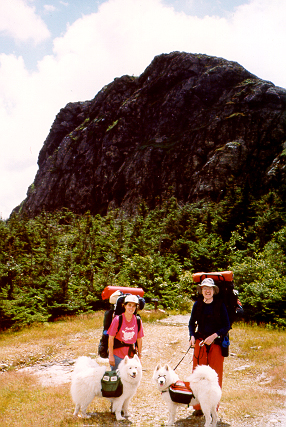 |
Mt. Mansfield
Nico and I started hiking stretches of the Long Trail in 1991, when he was one year old. I had been hiking around northern Vermont since the 1980s, when I lived in Boston and was visiting my parents in the summer. They lived in the northernmost tip of Vermont, about 20 miles from Quebec. My brother hiked the entire trail in one go, around 1990, and I hiked three days with him then, before Nico. When I started hiking with Nico, we started hiking stretches of the trail without really a plan, a few new hikes every summer, until the goal of hiking the whole thing fell in place. It was natural to start out in the north, which is the direction less traveled. But it was a lucky thing we did, since we only had a few days at a time to hike and we were at it for 11 years, and it meant we could save the easiest stretches of the trail for Nico to do in his most senior years.
Those eleven, really twelve, years took Nico from adolescent to senior citizen. In those twelve years my life changed too. I moved to Pittsburgh, got a job, got married, lost a job, adopted my daughter, and lost my brother. Our last three years on the Long Trail were dedicated to the memory of my brother.
In the beginning Nico and I were learning to dogpack. I had been backpacking since I was two, but had never done any dogpacking. The right place for a packing dog is behind his person on the trail. There are many good reasons for this. You can keep the dog from chasing critters on the trail. Some of those critters you’d like to get a chance to appreciate yourself, and some you’d rather your dog didn’t chase. (Nico once tried to pounce on a baby rattlesnake in West Virginia.) The dog is next to you where you can grab him if necessary. (I sometimes worried about what would happen if we had a face-to-face encounter with a moose or a bear, but it never happened. In Vermont these animals would rather avoid people if possible, and the bear are much less forward than in the Adirondacks of northern New York State.) By keeping your dog with you, you are assured of not losing him in the mountains. I have seen so many sad notices posted by people who have lost their dogs while hiking. A dog carrying a pack could easily get hung up on something and starve. If you have your dog right next to you, you can also keep a close eye on his condition. I learned to watch my dogs’ faces closely, the length and color of tongue, color of gums, brightness of eyes, expression of ears and face, for gauging signs of overheating. I was always worried about overheating, and I talked to vets about it often. But it’s usually cooler in northern Vermont than in some other places, and the trail is mostly shaded, and we never got into trouble that way, although I worried about it.
One of the most important reasons for keeping your dog next to you on the trail is so that he doesn’t scare or startle other hikers, or tangle with other dogs on the trail. I — and my dogs — certainly don’t appreciate being accosted by strange dogs bounding up the trail without their owners. More and more places are banning dogs from trails, for reasons like this. I don’t want to lose my places to hike with my dog, so Nico and I tried to be missionaries for good public relations for dogpackers, and to spread the word of proper dogpacking etiquette. Here’s a quick commonsense list, for anybody who wants to get started packing with their dog:
Dog Packing Etiquette
- Keep your dog under control;
- Keep your dog next to you on the trail;
- Keep your dog out of any water supply;
- Always ask permission before your dog approaches anyone. Before sharing a shelter or camping space with people ask if they mind dogs. On only one occasion did I find someone that objected to dogs, and I put that down to some irresponsible dogpacker before me.
- Keep your dog to yourself.
- Don’t let him soil on the trail.
Come equipped for your dog as well as yourself. Bring first aid and food for your dog of course, but also bring WATER. I’ve seen people out on the trail without water for their dogs, just assuming their dog would find it on the trail. But this is not good thinking, because there may or may not be enough water on the trail, and dogs need more water than humans to keep cool. People also get into trouble by not considering the heat; I have met hikers who found out the hard way that dogs cannot work in as much heat as humans can. Finally, consider carefully and honestly whether your dog’s competence and conditioning are up to the requirements of the trail. I met quite a few Appalachian Trail thru-hikers who had started out with their dogs, but had had to send their dogs home, because the dog couldn’t handle the hike or the heat. I’ve heard of rescuers in the White Mountains of New Hampshire bringing down dogs from the high peaks because they just couldn’t handle the rocky stretches, and got stuck.
These stories make it so much more impressive to me that our Samoyeds (and my Nico) can do this sort of thing.
In the beginning it was a struggle to get Nico to walk behind me. First I tried an idea I got out of a book: tapping him on the nose with a long stick whenever he moved up in front of me. I gave that up fairly quickly. He learned to dodge and come around the other side of me, and I couldn’t hit the moving target. Besides, I was always afraid I’d hit his eyes. Then I tried to do it by replacing him in position by pulling him back with the leash each time he forged ahead. Gradually over the years, we worked it out somehow, though it did take miles of walking with his pack banging into the backs of my knees for days on end. We compromised on Nico walking beside me, when there was room, not always behind. This wasn’t like teaching the precise heeling
position of competition obedience after all. I devised a system of hanging a leash on my belt so I could leash and unleash him with ease as necessary.
 |
During these years, we were also doing other kinds of training. We did obedience, learning first by the old, sometimes heavy-handed correction methods. Sometime after Nico earned his CD, and two legs into his CDX, Nico turned off to obedience. So we put that aside, did some sheep-herding, learned clicker training, and started agility. (Nico started agility at seven, then earned his NA.) After that we went back to obedience, and finished the CDX the second time out. (We actually went into the utility ring in competition once, but that was enough of that, and we retired from obedience. That was the show where some judge asked me, ‘are you the person who was brave enough to take a Samoyed into the utility ring?’) But the interesting question is, how has this other training affected our dogpacking? It has seemed to me that the more work of any kind I have done with Nico, the more we understand each other and are able to act as a team. And basic good behavior and the most basic practical obedience commands are invaluable for any situation of being out with your dog. But I have found some specific commands useful. The stand stay was sometimes useful for loading or unloading a dogpack. A stay is useful if you want your dog to wait for you to get down a dicey place, before he comes barreling down after you. And I’ve even found the command to jump useful. One thing a dog needs to learn when he starts carrying a pack is that he is a new size and shape, and can’t fit through places he usually can. Once Nico couldn’t figure out how to get through a crack between two rocks, but as soon as I told him to jump, he saw that he could get over it. And agility training has been invaluable. (By the way, for anybody starting to dogpack, I always removed Nico’s pack if there was any weight in it before jumping down any distance, to avoid the impact on his joints.)
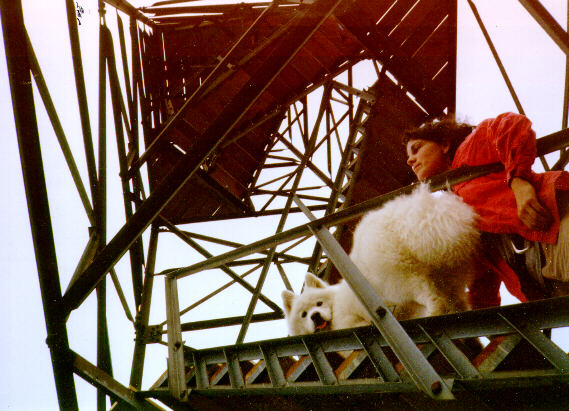
For those of you out west who think there isn’t any rugged hiking in the eastern US, the Long Trail (especially the northern part that doesn’t overlap the AT) has miles of trail where you can’t walk, but have to scramble up and down steep rocky pitches the whole way. We have gone from 1400 feet up to 4400 feet and back down to 400 feet in the same day. Nico always demonstrated the Samoyed versatility, adaptability, trust, sturdiness, independence, and good cheer. And no fear of heights. On one of our hikes Nico had to cross a narrow suspension bridge that swayed and bounced high in the air above a gorge. If he had refused to cross it we would have been stuck. I’m sure his agility training helped; and also that he trusted me. He has gone up ladders, climbed over stiles, and climbed or jumped up and down steep nearly vertical rock faces. Once, to access the trail, we rode up the mountain in a tiny gondola.
Sometimes there were places I had to lift him up or down, more as he got older. In spite of his agility training, we found one obstacle he couldn’t do: a vertical hanging ladder. When we found one of these he had to find another way around it. At one place on the trail where there was a hanging vertical ladder, I had to work my way along the cliff to find a place where I could coax him halfway down and catch him the rest of the way. I took my father (who was 75 at the time – another story) on that trip, and I was standing halfway up the cliff while my father stood below to catch us both. There was another sort of crevasse Nico couldn’t jump across, so I had to take him up the mountain a little way to where the crack was smaller and lift him up from the bottom. Sometimes Nico has an advantage over me with his four-paw drive; other times my opposable digit gives me the advantage.
Sometimes when we came to a very steep and rocky part of the trail, we would each have to find our own way down independently. This would get us into a comical situation, when Nico would get ahead of me, and then remember where he was supposed to be, and stop to wait for me, right where I couldn’t get past him. Then we’d be stuck on the top of some boulder halfway down.
Nico has hiked with me in every kind of weather except too cold. (How do you find that with a Samoyed?) We’ve been caught in thunderstorms on the trail. One time in the middle of a thunderstorm, we were hunkering down in a low spot waiting it out. The spot where we were hunkering was turning into a stream and we were getting soaked through. Both dogs were with us, and both dogs are terrified of thunderstorms. My younger dog Fiona panicked and it was all I could do to hang on to her. Nico just hunkered down and tried to hide underneath me. He knows how to hunker down, which seems to me like a kind of wisdom.
Once we wound up hiking during a record-breaking heat
wave. For the dogs’ safety, we started early in the morning, carried extra water, moved slowly, stayed in the shade, and dunked the dogs in every beaver pond we could find. Nico was deliberate and good-natured as always.
We hiked in drought. That was hard because we had to carry a lot of extra water, on top of all our other gear, and water is heavy.
 |
Up until the last couple of years, Nico carried all his own load, including a minimum of two quarts of water. The summers when I carried baby Ruth on my back on day-hikes I couldn’t carry the baby PLUS everything we needed for a day in the mountains, so that made Nico REALLY a working dog, because he had to carry some of Ruth’s necessary gear, as well as his own.
On one trip, Nico had to endure a painful paw. He hurt his paw and had to walk out on it because I couldn’t carry him.
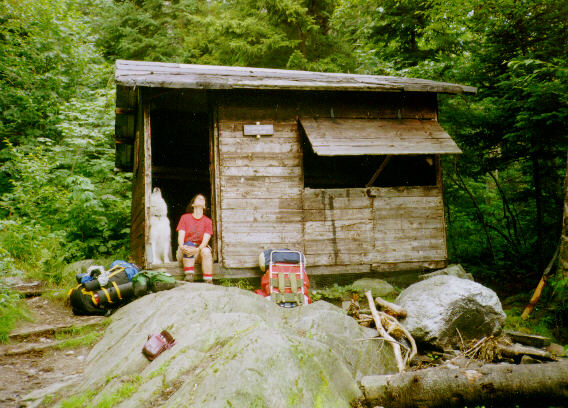
The Green Mountain Club has built a number of open-fronted shelters along the trail, and these are handy places to stay overnight. Very often on the trail there is no open space among the trees flat enough to pitch a tent anyway. We often took a tent or tarp nonetheless, in case there was someone in a shelter who didn’t want dogs. Later on we reduced the load to a tarp. There was one time we were very glad to have brought a tent. We took a side trail which we thought would be a shortcut, and this turned out to be a mistake under the circumstances. There had been much rain, and the trail was nearly impassable with large packs, wet rocks, and dogs, and growing dark too. We came to a vertical ladder just as it was getting too dark to find a way around it or find blazes to continue the trail. So we hauled the packs and maneuvered or hoisted the dogs, down the rocks to the bottom of the notch, where we found a flat spot to quickly pitch a tent, just as a big rain came up. We crawled in and everyone went to sleep except me. I stayed up worrying about the rain, because we were right under the notch, with lots of little streams around us, but it was the only place we could find to pitch a tent in the dark. For all my worrying, no flood came to wash us away.
Nico learned to hike behind me or next to me on the trail, so in the last several years, I almost never had to leash him on the trail. He could restrain himself from chasing critters in front of me on the trail, although he sometimes went after chipmunks to the side, and once he went after a porcupine down the mountain. Fortunately I caught him before he caught the porcupine (I always carried a pair of needle-nose pliers with me, as if I needed the extra weight, but porcupines are too common in northern Vermont.) Probably he COULD have caught the porcupine but was using his brain, unlike his half-brother Chester, who got into nine porcupines during his life. Once down in West Virginia, Nico held a stay behind me while we watched a tiny fawn a few feet ahead of us on the trail. He couldn’t contain himself forever, and after a long time he gave one bark, and the fawn skedaddled. Around a beaver pond he gets so excited I still have to leash him. Sometimes I know there are critters around us in the woods that I can’t see, because I see my dogs getting excited about a scent. I wish they could tell me.
Even at thirteen, he can still hike cheerfully and competently along the trail, bounce a little, and still have energy left over to chase the occasional chipmunk. He looks tired sometimes, but never really distressed or unhappy. Though he doesn’t see or hear as well as he used to, he still takes an interest in the smells and sounds of the trail. I hope I can do as well when I am in my nineties.
I have to thank my family who hiked with me at various times – my parents, brother, sister, and boyfriend, later husband. They helped to care for my daughter when I could no longer carry her on the trail. My father did many car shuttles in the north. My husband Charles supported Nico and me in our goal in so many ways that we could not have finished the trail without his support.
Nico loved the Long Trail. He loves the scents and sounds of the woods and the mountains, moose, beaver, bear. We heard moose calls and started up pheasants, walked for miles in the fresh tracks and droppings of moose. I loved it when he was walking right next me, cheery and alert and excited by something on the trail, with his eyes bright and tail and ears high. But maybe what he liked most was the companionship of the trail. He loved being with me on the trail, and I loved being with him. Sometimes we hiked with various family members, and when my younger dog Fiona joined the family, she came on most of the trips. But many times it was just me and Nico. We walked the whole thing together, the two of us, every step of the way, and he could look at me with his eyes and communicate everything. We still have some walks ahead of us but that was our grandest.
PostScript: Nico died in my arms in 2003, at the age of fourteen and a half. I scattered his ashes on the Long Trail.
 Carol Tenny Dog Training and Teaching